Pretty Edible Plants
Fruit & Nut trees, shrubs, vines and more
Pretty Edible Plants
Fruit & Nut trees, shrubs, vines and more
Chestnut, Sweet
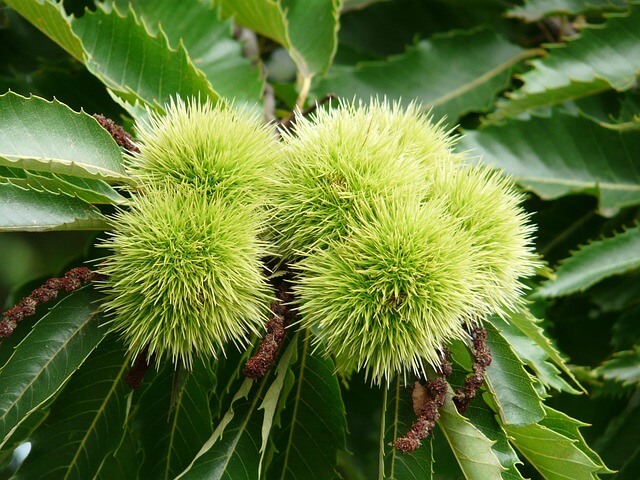
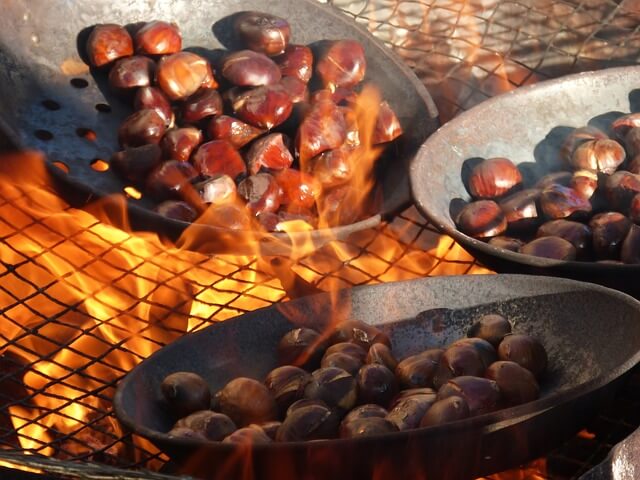

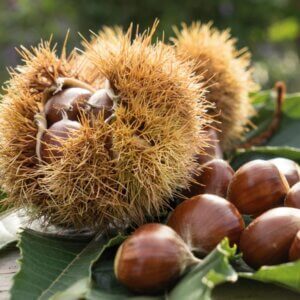
Beautiful, large, spreading nut trees, Chestnuts feature long, tropical looking, glossy green foliage and showy cascades of fragrant, yellow male catkins. In the fall you can harvest abundant crops of sweet and nutritious nuts encased in unique, spiny, golden brown balls. Unique among nuts, Chestnuts are high in starch and are delicious roasted or boiled. If you do not eat your nuts shortly after harvest, it is best to refrigerate them in plastic bags to keep them from drying out.
Just a short 120 years ago American Chestnut trees once filled the forests in the Eastern U.S. In the fall, people and animals alike looked forward to collecting the nuts that littered the forest floor. But, sadly, at the turn of the 20th century, the chestnut blight hit. Originally from Japan, no one is quite sure who was responsible for importing the fatefully blighted tree or seed that brought Chestnut Blight to the USA. But, it had a devastating affect on our native chestnut trees which had little to no resistance. Within 50 years, the blight had forever altered the landscape of the Eastern U.S. forests as it nearly wiped out what had once been a very important food source, and reduced (in most cases) the mighty American Chestnut to a multi-branched shrub that rarely produces nuts.
 Most chestnut trees grown in North America now are either European chestnut, European crossed with Japanese hybrid, or Chinese Chestnut. Though, there are still a few isolated stands of American Chestnut that have managed to survive. The
Euro/Japanese hybrids produce the largest nuts and the most nuts per area of tree cover. However, The European chestnut trees as well as the American chestnut trees are both vulnerable to chestnut blight to varying degrees, from susceptible to highly resistant. Once exposed to blight, the susceptible trees will die within a few years. Thankfully, in our area west of the Rocky Mountains chestnut blight is not present because it likes warm humid summers. And as most residents of the general Spokane area know – those are not the kind of summers we have around here!
Chestnut trees can grow fast and tall if the conditions are right. In the early years, growth can be as much as 4-6 feet of new growth. As the tree ages, growth slows down to about 18 inches a year. Trees with more European or American genetics in them can mature at 80-100 feet with American genetics getting the tallest. Japanese and Chinese chestnut trees tend to stay smaller, maxing out at about 30-50 feet tall. Healthy Chestnut trees can be very long-lived reach ages of well over 1000 years.
Spacing: most sources recommend planting 35-40′ apart. To get higher early yields per acre, they can be planted 20×40 feet apart or even much closer such as 10 feet apart followed by gradual removal of inferior trees as they grow.
Pruning: For best nut production, there should be some space between adjacent tree crowns. In other words when the branches of adjacent trees begin to overlap, it’s time to do some pruning or tree removal. When trees are young, it’s best to do little or no pruning – let the trees develop as many leaves as they can and grow as fast as they can. As trees get older and start to bear nuts, lower branches can be gradually removed to allow mowing and harvesting. Also, trees should be pruned down to one main stem.
Tolerances:
Special Uses:
| Habits:
|
Shopping Cart